Improving Translational Research for Chronic Pain

Many studies, one shared protocol

We harmonise preclinical and clinical protocols for chronic pain research to accelerate translational biomarker discovery and improve patient outcomes.

13network members
8countries

The problem

Why harmonisation matters

A gap between lab and clinic

Although suffering of patients with chronic pain is obvious and many efforts in pain research have been undertaken, there is a big gap between preclinical and clinical research (i.e., results from animal and human studies) hampering improved pain management and patient stratification for treatment options, as most biomarkers/drug targets identified in preclinical research have not been shown to be relevant for patients³⁴.

Results that do not compare

Even within clinical (as well as preclinical) studies, comparability is hampered by heterogeneous study protocols, differing measures used to assess outcomes, etc.

All this is hampering comparison and translation from preclinical to clinical studies (and vice versa).

A multidisciplinary network

Within this network, we will bring together world-leading experts from many different disciplines with great experience in pain management, preclinical and/or clinical pain research, and study design.

Read the full project rationale

Objectives

What the network will do

  1. We will compare study protocols/CRFs from previous preclinical and clinical studies related to chronic neuropathic, musculoskeletal, visceral, pelvic, and postsurgical pain generated within several consortia in which network members have been involved.
  2. We will start developing a server infrastructure to share large data sets from previous studies and to unify currently available data (and data assessed in future chronic pain trials) related to chronic pain, which will lead to best practice for data handling and sharing
  3. We will analyse existing datasets from previous studies to assess the comparability and integrability of several datasets (e.g., CRF, PROMs from clinical and behavioural readouts from preclinical studies, *omics data), which will allow to identify translational biomarkers for chronic pain across preclinical and clinical studies (and pain aetiologies) in the future.
  4. We will design recommendations on harmonisation of study protocols related to animal pain research and human pain trials based on data analysis in literature searches and discussions between all stakeholders (including researchers, clinical scientists, clinicians, data analysts), patients, and pain societies by finding a valuable consensus

The framework

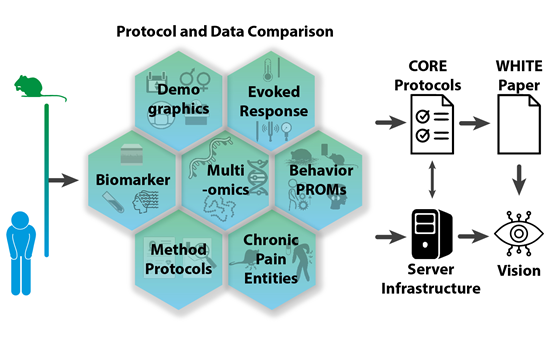
Protocols and data, brought together

Diagram: hexagons for demographics, evoked response, biomarkers, multi-omics, behaviour and PROMs, method protocols and chronic pain entities lead to core protocols, a white paper and a server infrastructure.
Harmonised protocols and data feed core protocols, a white paper and a shared server infrastructure (NeuroERAnet Figure 4).

The network

People behind the project

Meet the partners

Questions about the project?

Write to the project coordinator through the contact form.

Contact